Every successful business begins with a clear strategic direction
Growth rarely happens by chance. Organizations that consistently achieve long-term success are those that invest time in defining clear objectives, understanding market dynamics, and making informed business decisions. A well-developed strategy provides structure, reduces uncertainty, and enables businesses to respond confidently to changing market conditions.
Whether you are launching a new venture or managing an established organization, strategic planning serves as the roadmap that connects your vision with measurable business outcomes. It helps leaders prioritize resources, identify opportunities, and maintain focus on long-term objectives while adapting to day-to-day operational challenges.
"Sustainable growth is achieved through deliberate planning, informed decision-making, and the ability to adapt with confidence rather than react under pressure."
MB Ekko Dreams
Turning strategy into measurable business outcomes
A well-defined strategy creates alignment across the entire organization. Leadership teams gain greater clarity when setting priorities, employees understand organizational objectives, and business decisions become more consistent.
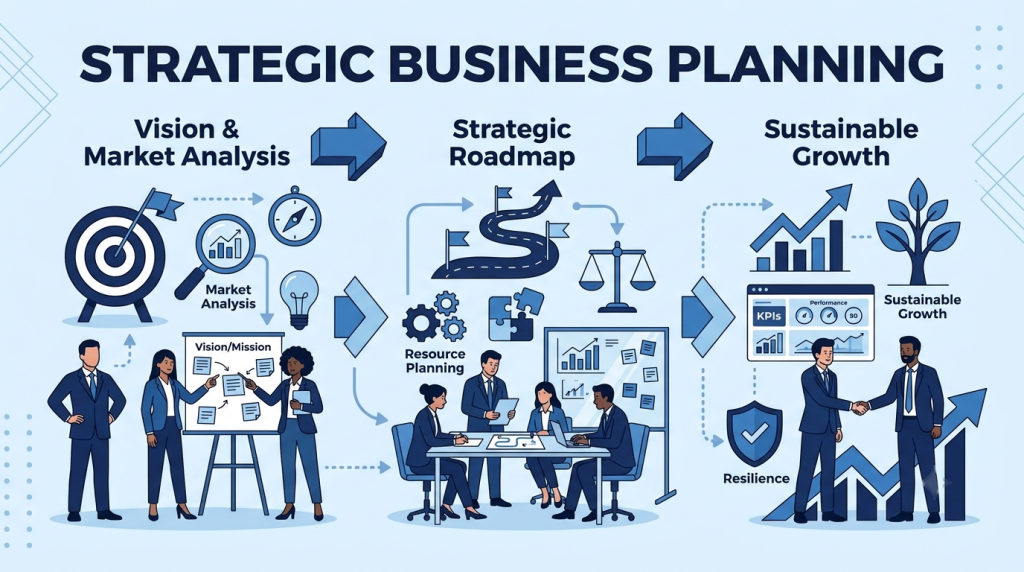
Organizations with structured strategic planning often experience improvements in operational coordination, resource allocation, and long-term decision-making. Instead of responding to challenges as they arise, they develop proactive plans that support resilience and sustainable growth.
Strategic planning also encourages businesses to monitor performance, evaluate market trends, and continuously refine their approach as business conditions evolve.
Key elements of an effective business strategy
A comprehensive business strategy typically includes several interconnected components that work together to support organizational success.
- Clearly defined business vision and long-term objectives.
- Market analysis and competitive positioning.
- Identification of business opportunities and potential risks.
- Resource planning and operational priorities.
- Performance measurement and continuous strategic review.
- Scalable growth planning supported by measurable milestones.
- Technology alignment with overall business objectives.
When these elements are developed together, organizations establish a stronger foundation for sustainable business performance and future expansion.